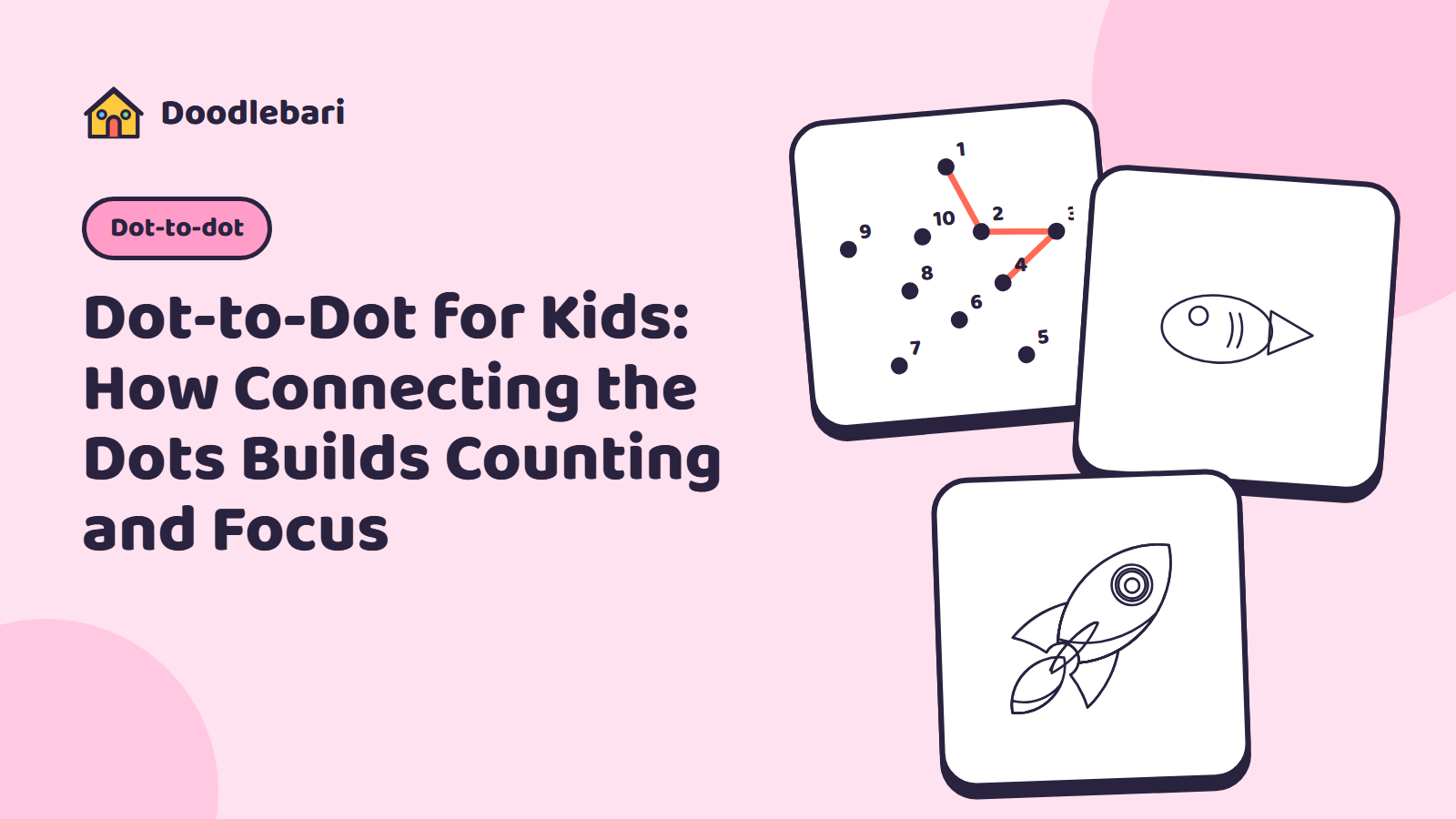
There is a special kind of excitement when a jumble of numbered dots slowly turns into a star, a fish or a car. Dot-to-dot puzzles (also called connect-the-dots) have been a children's favorite for generations — and for good reason. Behind the fun, they practice several important early skills at once.
What dot-to-dot puzzles teach
Number order and counting
To finish a puzzle, a child has to find 1, then 2, then 3, and so on. That is number sequencing — understanding that numbers come in a fixed order and each one is "one more" than the last. It's a foundation for counting, adding and much of early math.
Number recognition
Before children can count to 20, they need to recognize what "14" looks like and not confuse it with "41". Hunting for the next number on the page is focused, repeated practice at reading numerals.
Visual scanning
Finding the next dot means searching the whole page in an organized way. This visual scanning skill later helps with reading, where the eyes need to move smoothly across a line of text.
Fine motor control
Drawing a line from one dot to the next — or tapping precisely on a small dot — trains controlled, deliberate hand movements.
Patience and the reward of finishing
Dot-to-dot has a built-in mystery: what will it be? That curiosity keeps children going, and the reveal at the end is a satisfying reward for their patience.
Choosing the right puzzle for your child's age
- Ages 3–4: 5–15 dots, big and well spaced. Count along together and say each number out loud.
- Ages 4–6: 15–30 dots. Your child can begin to find numbers on their own; help only if they get stuck.
- Ages 6–8: 30 dots and more, including numbers beyond 20. Some children enjoy counting in twos or fives.
It's better to start too easy than too hard. Success builds confidence; frustration builds avoidance.
How to make dot-to-dot more fun
- Guess the picture before starting, and again halfway through.
- Color it afterwards. Turning the finished outline into a colorful picture doubles the fun — Doodlebari does this automatically, turning every finished puzzle into a coloring page.
- Count out loud together, especially past tricky numbers like 13 and 30.
- Make your own by drawing dots around a simple shape for your child to connect.
Paper or screen?
Printed puzzles with a pencil build grip and line control. On-screen puzzles are great for younger children, who can tap each dot instead of drawing a line, and they never run out. The best choice depends on your child's age and what you have to hand — many families use both.
Play free online dot-to-dot games
Doodlebari's dot-to-dot puzzles for kids highlight the next number to find, draw each line as it's tapped, and reveal a mystery picture to color at the end. They're free to play in the browser with no sign-up.
Frequently asked questions
What age are dot-to-dot puzzles for?
Simple puzzles with 5–15 dots suit most three- and four-year-olds with help. By five or six, many children can complete 20–30 dot puzzles on their own.
My child skips numbers. What should I do?
Slow down and count together from the last number they found. Choosing a puzzle with fewer dots for a while often helps.
Do dot-to-dot puzzles help with math?
Yes. They give lots of practice with number order, recognizing numerals and counting on — skills children use in early addition.