Most children don't wake up one morning able to write their name. They get there through a long series of small steps — scribbles, lines, circles, shapes and finally letters. Letter tracing sits right in the middle of that journey. It shows a child where a letter starts, which way to go and when to stop, so they can build the movement before they have to invent it.
This guide walks through when to start, what order to teach letters in and how to keep practice fun.
When is my child ready to trace letters?
Every child develops at their own pace, but a few signs suggest a child is ready:
- They can draw a straight line up and down, and side to side.
- They can make a rough circle.
- They show interest in letters — pointing at signs or asking what words say.
- They can sit and focus on a small task for a few minutes.
For many children this happens between ages three and five. If your child isn't there yet, spend time on pre-writing lines and shapes first — it's time well spent.
Step 1: Start with lines, curves and zigzags
Letters are made of a small set of strokes: vertical lines, horizontal lines, diagonals, curves and circles. Tracing those strokes on their own helps children practice the movements without the pressure of "getting a letter right." Doodlebari's tracing section includes whole sets of lines, zigzags, curves, loops and shapes for exactly this reason.
Step 2: Teach uppercase letters first
Capital letters are mostly made of straight lines and simple curves, and they all sit the same height. That makes them easier for young hands. A common approach is to group letters by the strokes they use:
- Straight lines only: L, T, I, F, E, H
- Diagonals: A, V, W, X, Y, K, M, N, Z
- Curves: C, O, Q, G, S, U, J, D, P, B, R
Starting with L and T gives children quick wins before they tackle curves.
Step 3: Always start at the starting point
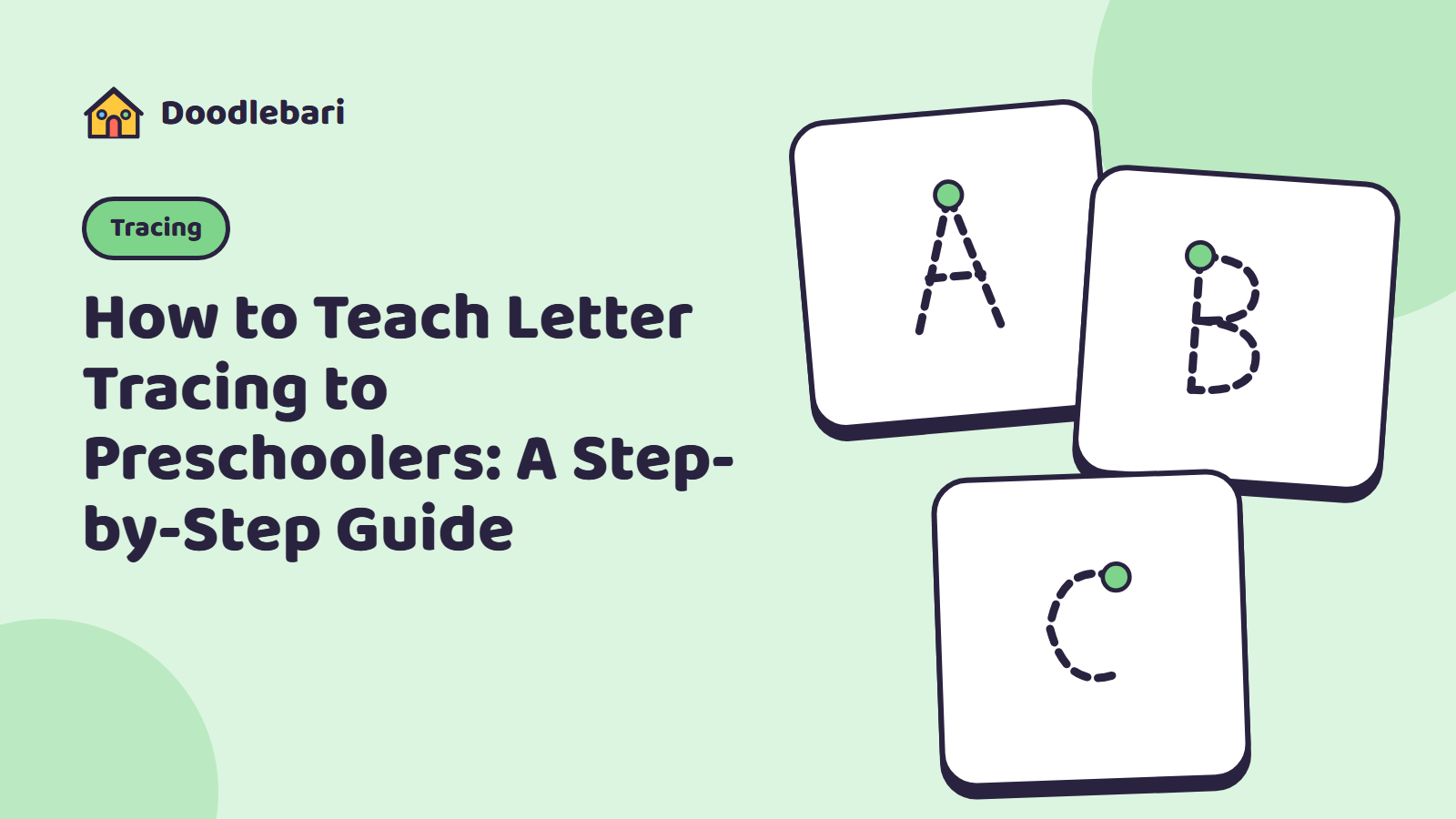
The most important habit in early writing is where a letter starts. Most letters start at the top. In Doodlebari, every tracing card shows a green dot with a number where each stroke begins, and the strokes must be traced in order. This builds correct stroke order from day one, which makes handwriting faster and neater later.
Step 4: Say it while you trace it
Talk through each stroke: "Big line down. Back to the top. Little line across." For letter sounds, link the letter to a word your child knows: "A is for apple." Hearing, seeing and moving together helps the letter stick. Each tracing card in Doodlebari shows a matching word once the letter is finished.
Step 5: Keep sessions short and positive
Three or four letters a day is plenty for a preschooler. Stop while it's still fun. Celebrate effort rather than perfection — wobbly lines are completely normal. A child who enjoys tracing will come back to it; a child who is corrected on every stroke may avoid it.
Step 6: Move from tracing to copying to writing
Once a letter feels easy to trace, try:
- Copying: your child writes the letter next to a model.
- Writing from memory: you say the letter, they write it.
- Writing their name: the most motivating word there is.
Fun ways to practice letter tracing
- Trace letters in sand, salt or shaving foam with a finger.
- Make letters with play dough "snakes."
- Trace giant letters with a finger on a window or a parent's back.
- Use a tracing app for short, guided practice with instant feedback.
Try online alphabet tracing
Doodlebari's letter and number tracing guides children from the green starting dot along dashed lines, checks each stroke and cheers when the letter is done. It's free to play in the browser, with no sign-up.
Frequently asked questions
Should I teach uppercase or lowercase letters first?
Most early-years educators start with uppercase because the shapes are simpler and more consistent. Lowercase letters usually follow once children are comfortable with lines and curves.
My child holds the pencil in a fist. Is that a problem?
A fist grip is normal for young children. Grip usually matures with age and plenty of hand activities like coloring, play dough and building blocks. If you're concerned, speak to your child's teacher or health visitor.
How long should tracing practice last?
For preschoolers, five to ten minutes is enough. Short, regular sessions work better than long ones.