When we think of learning to write, we picture letters. But every letter is built from a small set of basic movements: straight lines, curves, circles and diagonals. These are called pre-writing strokes, and mastering them makes learning letters much easier.
What are pre-writing skills?
Pre-writing skills are the abilities children need before they can write comfortably. They include:
- Pre-writing strokes — the basic lines and shapes that make up letters and numbers.
- Hand strength and grip — holding a crayon or pencil with control.
- Hand–eye coordination — guiding the hand with the eyes.
- Crossing the midline — moving a hand across the middle of the body, as when drawing a line from left to right.
- Posture and focus — sitting and attending to a task for a few minutes.
The basic pre-writing strokes
Children usually learn to copy these strokes in a fairly predictable order. The ages below are approximate — many children are earlier or later, and that's normal.
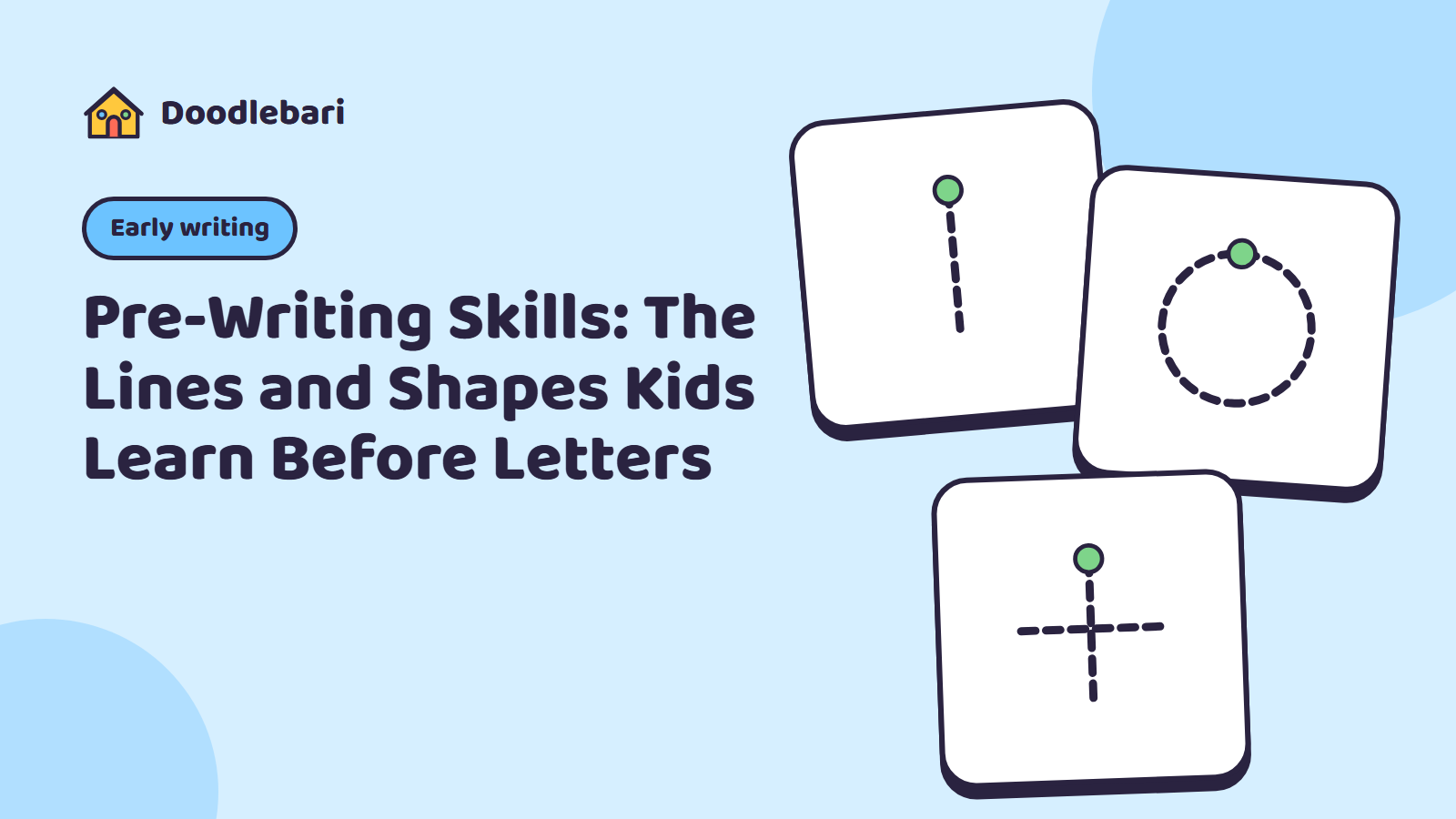
- Vertical line (|) — often around age 2 to 3.
- Horizontal line (—) — often around age 2½ to 3.
- Circle (O) — often around age 3.
- Cross (+) — often around age 4.
- Diagonal lines (/ and \) — often around age 4 to 5.
- Square — often around age 4 to 5.
- X — often around age 5.
- Triangle — often around age 5.
Notice how these build on each other: a cross is two straight lines, a square adds corners, and a triangle needs diagonals. When a child can draw a triangle, most capital letters are within reach.
Why this order matters
Letters like L, T, H and E use only straight lines. O, C and S need curves. A, K, M, V and W need diagonals. A child who is still working on straight lines will find "A" frustrating — but will likely manage "L" and "T" happily. Following the natural order keeps practice successful and fun.
Fun ways to practice pre-writing strokes
- Roads and rain: draw horizontal "roads" for toy cars and vertical "rain" falling from clouds.
- Snails and suns: circles become snail shells, balloons and suns.
- Mountains: zigzag lines make mountain ranges and crocodile teeth.
- Big to small: try strokes large first — in the air, on a whiteboard or in sand — before small ones on paper.
- Trace, then copy: tracing shows the movement; copying makes the child plan it.
- Tracing games: Doodlebari's tracing section has dedicated sets for lines, zigzags and angles, curves and waves, loops and circles, and shape outlines, each with a clear starting dot.
Signs your child is ready for letters
- They can copy a vertical line, horizontal line, circle and cross.
- They hold a crayon with some control rather than just scribbling.
- They're interested in letters, especially the ones in their name.
When those pieces are in place, it's a great time to move on to letter tracing.
Frequently asked questions
What is the first pre-writing stroke children learn?
The vertical line is usually first, followed by the horizontal line and the circle.
How can I help my child draw a circle?
Start big — circles in the air, on a chalkboard or with a finger in sand. Show where to start (at the top) and go round in one direction. Tracing circles also helps.
Is it a problem if my child is behind these ages?
The ages are only a rough guide and development varies widely. If you have concerns, talk to your child's teacher or health professional.