Children are remarkable language learners. Many families across Bangladesh and the Bangladeshi diaspora raise children who switch easily between Bangla and English — and many others would love to but aren't sure where to start. The good news: there's no single right method, and small, consistent habits work better than big plans.
Common myths about bilingual children
"Two languages will confuse my child." Children can tell languages apart from an early age. Mixing words from both languages in one sentence is a normal stage, not a sign of confusion.
"Bilingual children always start talking late." Most bilingual children reach language milestones within the typical range. If you're concerned about your child's speech, talk to a health professional — but don't drop a language on the assumption that two is too many.
"It's too late after age five." Earlier is easier, but children (and adults) can learn a second language at any age.
Popular approaches families use
One parent, one language
Each parent consistently speaks one language to the child — for example, one parent speaks Bangla and the other English. It gives children clear, reliable exposure to both.
Home language at home
The family speaks Bangla at home, and the child picks up English at school, nursery and from the wider world (or the other way round for families in Bangladesh who want stronger English).
Time or place
Some families choose Bangla at dinner or on weekends, or English during homework time. What matters most is regular, meaningful use.
Whichever approach you choose, consistency and warmth matter more than the method.
Everyday ways to build both languages
- Talk, talk, talk. Narrate daily life: cooking, getting dressed, walking to the shop.
- Read together in both languages. Bangla picture books and rhymes (ছড়া) are wonderful for rhythm and vocabulary.
- Sing. Nursery rhymes and songs in both languages stick in the memory.
- Connect with family. Video calls with grandparents are powerful motivation to use Bangla.
- Play in both languages. Name colors, shapes and animals in Bangla and English while you play.
Learning to read and write two scripts
Bangla and English use different writing systems, so children learn two sets of letters. A few tips:
- Start with the script your child sees most, and add the second when the first feels comfortable.
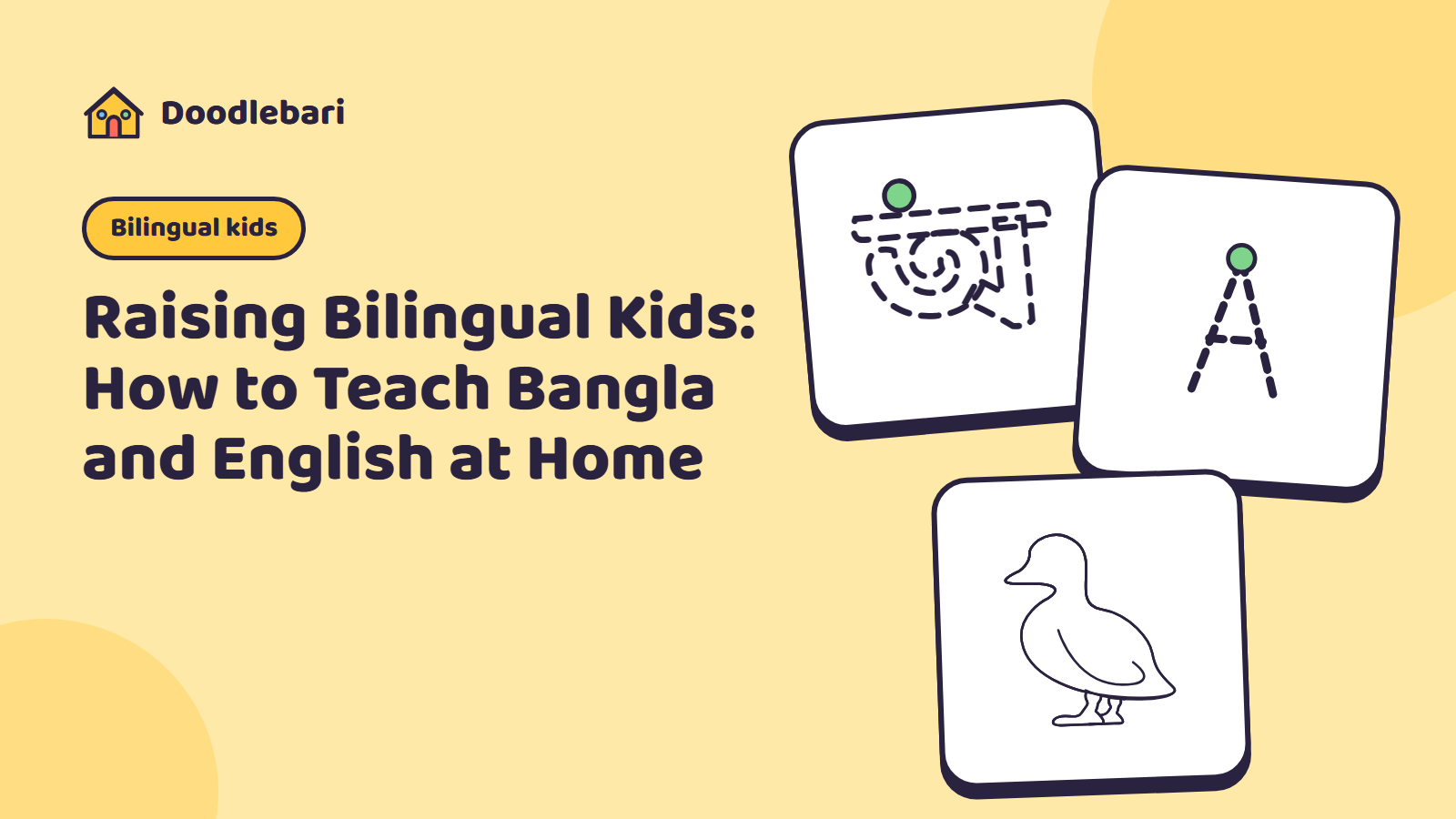
- Practice pre-writing strokes — lines, curves and loops — which help with both scripts. Our guide to pre-writing skills explains the basics.
- Keep practice short and playful: tracing, matching games and spotting letters on signs and packaging.
How Doodlebari can help
Doodlebari was built in English and Bangla from the start, and now also works in Hindi, Spanish, French and Arabic. Children can color, draw, trace letters and numbers and connect the dots with every button, instruction and celebration shown in the language you choose. Switching languages is one tap, so children can practice the same activity in both.
Keep it joyful
The biggest risk to bilingualism isn't confusion — it's a child deciding one language is boring or a chore. Keep the second language linked to fun, family and stories, and celebrate every new word.
Frequently asked questions
Will learning Bangla at home hurt my child's English at school?
Research on bilingual children generally shows that a strong home language supports, rather than harms, learning a second language. Children who are confident in one language can transfer many skills to the other.
My child answers in English when I speak Bangla. What should I do?
This is very common. Keep speaking Bangla warmly, gently repeat their answer in Bangla, and create situations where Bangla is needed, like calls with grandparents.
When should my child start learning the Bangla alphabet?
Many children start recognizing letters between three and five. Begin with play — songs, tracing and spotting letters — rather than formal lessons.